Trees are the perfect solution for hot play areas where kids hang out. Trees will cool the air and playing surface making it more enjoyable for outdoor playtime. Trees are also used by adults to enjoy both during the day and for afternoon/evening parties, or an intimate wine and cheese rendezvous with your partner.
Trees are also vital to help reduce UV rays, i.e. sun cancer.
Environmentally, trees are vital for a range of wildlife to nest in, to source food and to hunt from (such as owls, etc).
From the human perspective, trees connect us with nature – a term we refer to as biophilia.
Botanically, trees are anything over 5m up to 100m tall – that’s big for most people. Trees tend to have a single stem whereas shrubs are generally considered to have multi-stems that arise at ground level. That said, there are always exceptions to the rule in that some shrubs can be trained into trees and some trees pruned down into large shrubs (multi-stems).
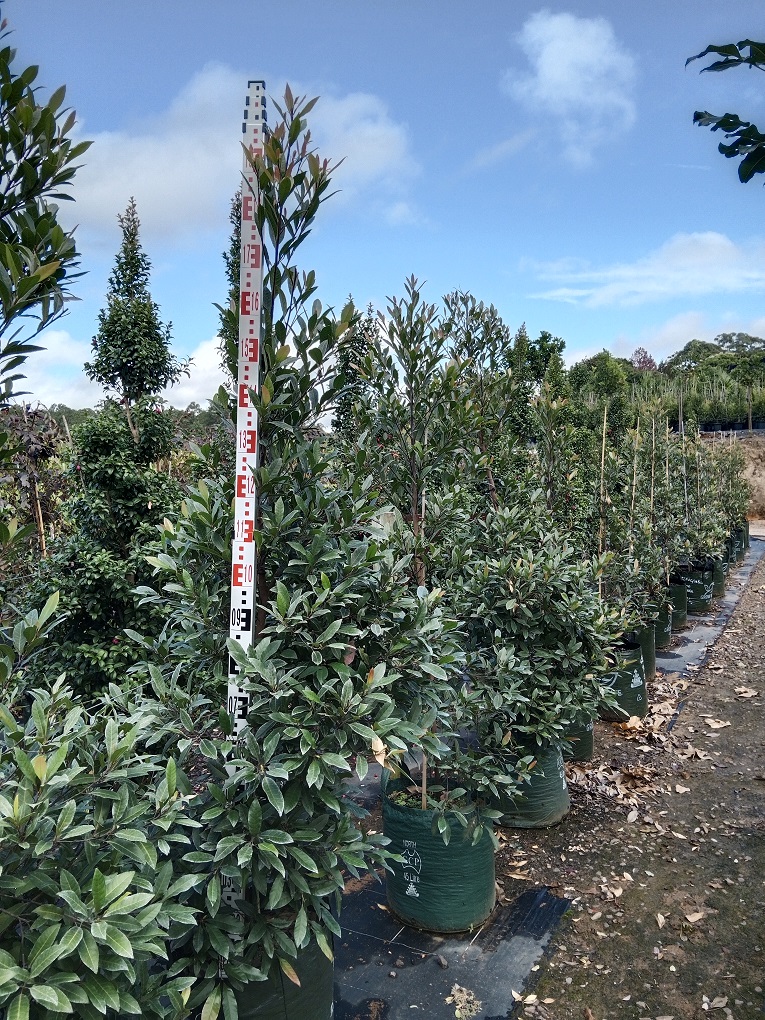
Small trees for landscape projects are typically 4-8m tall and are the ideal dimension for creating intimate spaces in private gardens or public spaces. Small trees are desirable by Council Authorities as they tend to be below the powerline height (reduces maintenance costs) and more in ‘human-scale’.
Likewise, many medium sized shrubs will grow into small tree dimensions which are ideal for small gardens.
It is worth noting that some labels and websites indicate certain tree species can potentially grow well over 10m or more in nature, however when grown in cultivation those exact species are generally much smaller (about 5-6m) due to sunlight and soil conditions.
Always remember this key phrase ‘the right plant in the right position’.
Here is a list of reliable small trees for local situations in the subtropical areas of South East Queensland (SEQ). Lists are alphabetical, not based on priority.
Feature Native Small Trees
• Buckinghamia celsissima – ivory curl flower
• Callistemon/Melaleuca sp. – bottlebrushes
• Elaeocarpus reticulatus – blueberry ash, ‘Prima Donna’, ‘Green Dream’
• Gymnostoma australianum – Daintree pine
• Harpullia pendula – tulipwood
• Lepiderema pulchella – fine leaf tuckeroo
• Leptospermum madidum (Aggreflorum longifolium) – weeping tea-tree
• Melicope rubra – little evodia
• Sarcotoechia serrata – fern-leaved tamarind
• Xanthostemon chrysanthus ‘Fairhill Gold’ (and ‘Expo Gold’)
Feature Non-native Small Trees
• Cerbera odollam – pong pong tree
• Cordia sebestena – geiger tree
• Lagerstroemia indica – crepe myrtle
• Loropetalum chinense – fringe flower
• Magnolia grandiflora ‘Little Gem’, ‘Teddy Bear’, ‘Super Gem’
• Mimusops elengi – red coodoo
• Plumeria pudica – fiddle-leaf frangipani (more of a shrub than tree)
• Radermachera ‘Summer Scent’ / ‘Everlasting Beauty’ – ‘Summer Scent’, ‘Everlasting Beauty’
• Tabernaemontana pachysiphon – giant pinwheel flower
• Tibouchina sp. (Andesanthus sp.) – cultivars ‘Alstonville’, ‘Kathleen’, ‘Noelene’
Scented Flowers Small Trees (large shrubs)
• Atractocarpus (Radia) fitzalanii – brown gardenia (native)
• Buckinghamia celsissima – Ivory curl flower
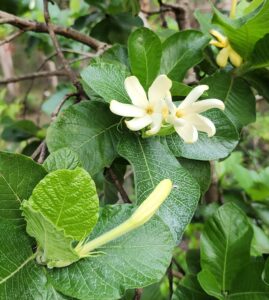
• Gardenia carinata – tree gardenia
• Gardenia mutabilis – Gardenia ‘Soleil d’Or’
• Hymenosporum flavum – native frangipani (native)
• Larsenaikia ochreata – Wenlok native gardenia (native)
Deciduous Small Trees
• Bolusanthus speciosus – tree wisteria
• Brachychiton bidwillii – little kurrajong (native)
• Brachychiton compactus – Whitsunday bottle tree (native)
• Cassia brewsteri – Leichhardt bean (native)
• Cassia marksiana – Mark’s cassia (native)
• Plumeria rubra – frangipani
• Schotia brachypetala – drunken parrot tree
• Handroanthus impetiginosus (Tabebuia palmeri), Tabebuia pallida, Tabebuia aurea – trumpet trees
Here at Plant Connections, we can supply these for your landscape projects. Some we grow here and others we can get in for you, depending on availability.
It is important to note that some tree species may need to be contract grown.
Contact us if you are seeking these plants or other species for your landscape project.