Bees, butterflies, other insects (moths, beetles, flies, wasps, etc.) and a range of animals (possums, gliders, bats, etc.) are all pollinators for plant life. They are all essential for gardens, parkland and urban spaces to thrive.
As awareness of their role grows, more councils, designers and gardeners are planting appropriate flowering plants and reducing pesticides to attract these important creatures into urban parks and private gardens. Some council authorities overseas and within Australia have removed grass verges replaced them with flowering pollinator-friendly species.
FOOD – Pollinators help increase fruit and vegetable yields by transferring pollen between flowers, boosting yield and creating edible fruit, seeds, and the next generation of plants.
Beyond food production, pollinators enhance garden biodiversity, support native ecosystems, and create a vibrant living landscape.
There is a global decline of pollinator populations, especially honeybees and butterflies. This is where landscape architects, designers and councils can play an important active role. Let us not forget our native bees and other insects.
Creating spaces for pollinators brings biodiversity closer to humans and enhances the space with natural beauty. It creates a landscape that will thrive season after season.
Our Top 12 Recommended Plants for Pollinators
[Alphabetically listed]
- Brachyscome sp. – Cut-leaf daisy – lovely groundcover plants with bright stary petal flowers.
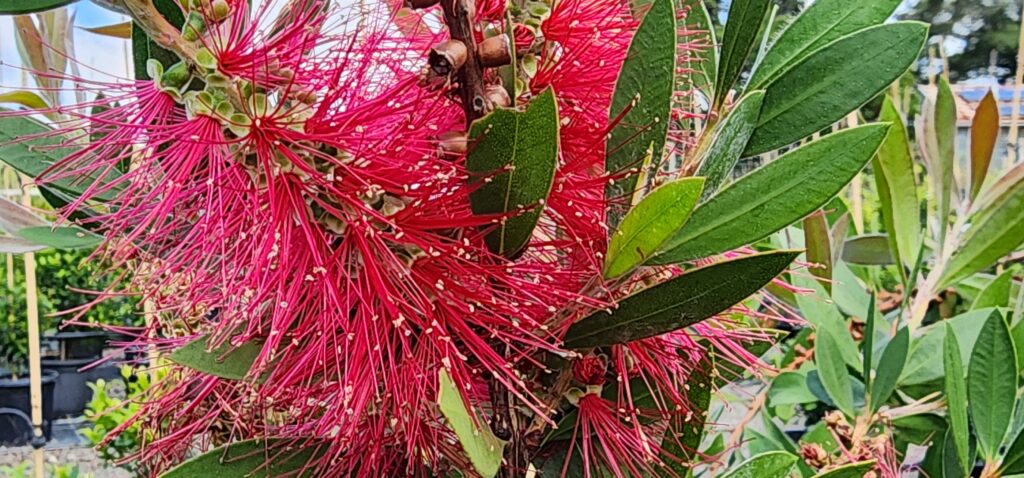
- Callistemon sp. – bottlebrushes – there are many species and cultivars on the market, ranging from groundcovers to shrubs to tall trees. No matter what the colour of flowers the bottlebrush has, pollinators make a beeline (pun intended) to these in flower.
- Cordyline – a popular foliage plant that attracts pollinators when in flower. If you are looking for a ‘tropical foliage’ plant and still want to attract pollinators, these are for you. Some of the best ones we recommend are:
Cordyline congesta (Australian native)
Cordyline fruticosa – these are the popular hybrid/cultivar forms with highly decorative foliage.
Cordyline manners-suttoniae (Australian native)
Cordyline petiolaris (Australian native)
Cordyline rubra (green leaves) (Australian native)
Cordyline stricta (Australian native)
- Cuphea hyssopifolia – false heather – compact popular garden plant that native bees love to visit. Flower colour range in includes white, pink or mauve.
- Daisies – all of them! These are world-wide recognised on every pollinator list. Here are some specimens we recommend.
Erigeron karvinksianus – the Mexican fleabane
Gazania – African daisy
- Gordonia axillaris (now Polyspora axillaris) – fried egg plant – a lovely large shrub (small tree) with camellia-like flowers that are highly attractive to bees and other pollinators.
- Leptospermum – tea tree – mostly shrubs, these nectar-rich flowers appear mostly during spring. Plants are native to Australia, New Zealand and Indo-China.
- Melaleuca – paperbark / myrtles – similar to bottlebrushes in some ways. Trees or shrubs. Highly attractive flowers to pollinators.
- Metrosideros – similar to our Australian native Myrtaceae specimens, Metrosideros are native to New Zealand, Pacific Island nations, southern South America, southern Africa. Nectar rich and abundant pollen flowers are a goldmine to attract pollinators. Some of the best we think landscapers should use are:
Metrosideros ‘Springfire’ (considered to be Metrosideros collina var. villosa)
Metrosideros collina ‘Little Dugald’
Metrosideros collina ‘Little Ewan’
Metrosideros excelsa (often sold as Metrosideros thomasii)
- Vitex rotundifolia – beach vitex – a lovely groundcover with blue flowers that both honeybees and native bees seem to adore.
- Xanthorrhoea – grasstrees – when in bloom, tall spears carrying hundreds of flowers attract a wide range of pollinators. Slow grower but worth the dollars and patience.
- Xanthostemon sp. – when in flower, these plant are some of the best magnets for pollinators and the heady honey-scent is also a bonus. There are many species, all are worth getting but these are reliable specimens for South East Queensland (subtropics):
Xanthostemon chrysanthus – Golden Penda (tree)
Xanthostemon chrysanthus ‘Fairhill Gold’ – Fairhill Gold (large shrub)
Xanthostemon chrysanthus ‘Little Goldie’ – Little Goldie (small shrub)
Xanthostemon verticillatus – Little Penda / Bloomfield Penda (medium shrub)
We recognise that different climate zones and different growing conditions may prefer a different listing of plants. There are also many other plants we would have added to this list (e.g. banksias, etc.) but at we limited it to only twelve ‘main’ groups for this article post.