5 best groundcovers for coastal and non-coastal areas
This is a topic often discussed among horticultural professionals (horticulturists, garden designers, landscape architects, landscapers and councils), each group putting forward their preferred plant specimens. Sometimes the same plants will appear on lists from various professional groups, sometimes no plants are the same.
The reason for different plants on the lists is because different landscape sites have different conditions – sunlight, wind, ocean breeze, clay versus sandy soil, pH range, flooding, etc.
Sometimes it is a human preference factor – preference for native versus non-natives, scented or not, flower colour, wildlife attracting, kid-friendly, pet-friendly, non-poisonous, etc.
This list is based on our expertise in the local area and selecting plants that are hardy to most situations, have a proven track record of success over the long term, and easy to look after.
It is by no means discrediting other plants that may fit this criteria – it is our recommendation for local situations.
BEST GROUNDCOVERS FOR COASTAL AREAS IN SE QLD – Top 5 (Alphabetical listing)
• Carissa ‘Green Carpet’ – a lovely groundcover with thick oval leaves and white flowers. Creates a carpet effect once established. Small thorns occur on the underside of the nodes. Related to the popular shrub form Carissa ‘Desert Star’. Full sun.
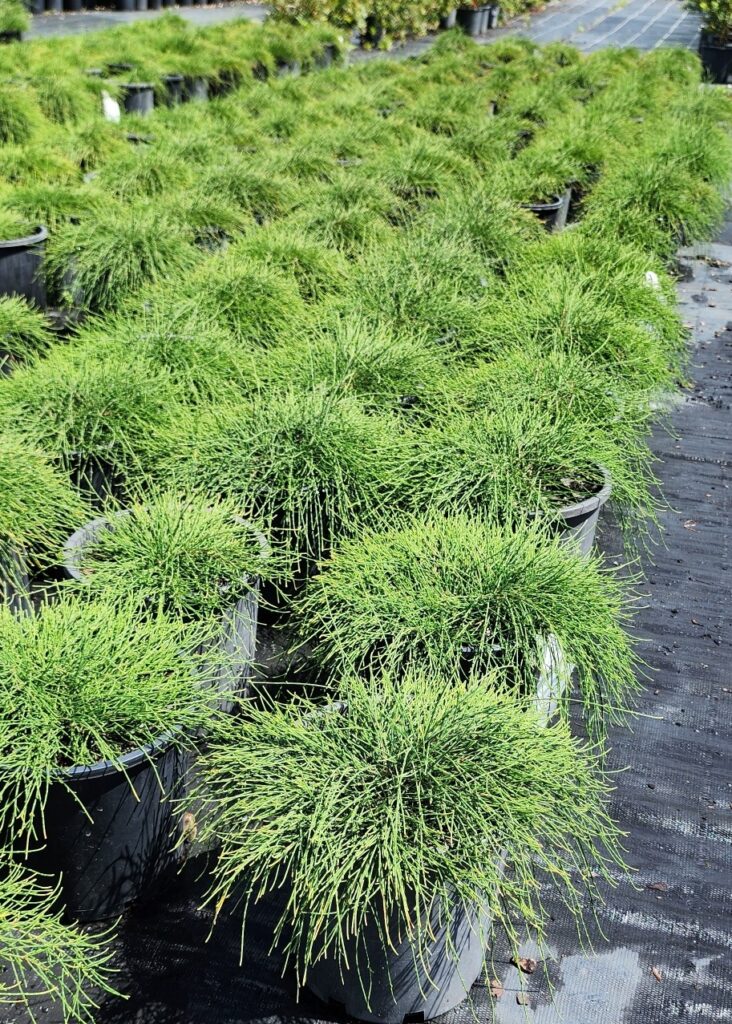
• Casaurina glauca ‘Cousin It’ – a fascinating native groundcover that has needle-like leaves and looks best when hanging over the edge of a garden or spreading out. Full sun.
• Juniperus confertus – shore juniper – a native to Japan, this groundcover is popular with councils due to its capacity to thrive on neglect once planted, which is why it’s in this top 5 list. Full sun.
• Vitex rotundifolia – beach vitex – a native groundcover with grey-green foliage and clusters of blue flowers. This plant roots at nodes as to spreads along the ground making it a good alternative for bank stabilising projects. Full sun to part shade.
• Zoysia tenuifolia (now called Zoysia matrella) – temple grass, no-mow grass – is a native grass species that produces a tight matt along the ground but can then form mounds when left untouched. Not a grass to walk on. Full sun.

BEST GROUNDCOVERS FOR NON-COASTAL AREAS IN SE QLD – Top 5 (Alphabetical listing)
• Acalypha reptans ‘Stephie’ (now called Acalypha chamaedrifolia ‘Stephie’) – commonly called red cat’s tail, kitten’s tail, summer love, or dwarf chenille – is a ground-hugging tropical plant that is perfect as an understory mass planted featured but can also scramble up and through low profile mesh fences. There is pink colour flower form too. Part shade to full sun.
• Evolvulus pilosus (now called Convolvulus prostratus, though regarded by many horticulturists as Evolvulus glomeratus) – Brazilian dwarf morning-glory, blue eyes, sapphire blue – botanically it is a confusing mess, but the plant is a tough hardy groundcover loved by many gardeners. Grey-green soft fury leaves and blue (a white flower cultivar is available) makes this a lovely addition to many gardens.
• Trachelospermum jasminoides – star jasmine – though it is often seen as a climber, this plant can create a wonderful groundcover provided there are no climbing structures (fences, posts, shrubs, trees, etc) nearby. The scented star-flowers are a big bonus. Full sun to part shade.
• Tradescantia spathacea (previously known as Rhoeo discolor) – Moses in the cradle – has long been used as a reliable succulent-like groundcover. It has lush green leaves with a purple underside. The dwarf variegated version is the extremely popular and highly desired ‘Stripe Me Pink’ due to the attractive pink colouration. Part shade.
• Viola hederacea – native violet – would be one of the most commonly used native groundcovers in private gardens and commercial landscapes. It does best in part shade.
It is worth noting that the “COASTAL” specimens may also be used in the “NON-COASTAL”, but not necessarily the reverse.